




Art terms on "N"
Nabis
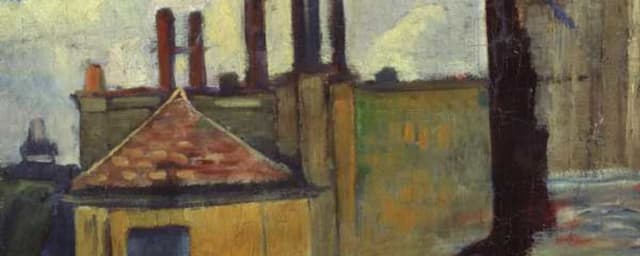
The Nabis were a group of Post-Impressionist French painters active from about 1888 to 1900, whose works are distinguished by flat patches of colour, bold outlines and simplified, decorative drawing. The name derives from the Hebrew word 'nabi' ('prophet') and reflected the semi-secret, almost mystical character of the association. The group arose under the influence of Paul Gauguin and the Pont-Aven school; the immediate spark was a small 'talisman' picture that Paul Sérusier painted under Gauguin's guidance. The Nabis included Pierre Bonnard, Édouard Vuillard, Maurice Denis, who formulated the famous dictum that a painting is above all a flat surface covered with colours in a certain order, as well as Paul Sérusier, Ker-Xavier Roussel and Félix Vallotton. The Nabis erased the boundary between high and decorative art, working on panels, stained glass, theatre sets, posters and book illustration. Their leaning toward flatness, symbolism and ornament made the group an important link in the passage from Impressionism to Modernism and Art Nouveau.
Read more →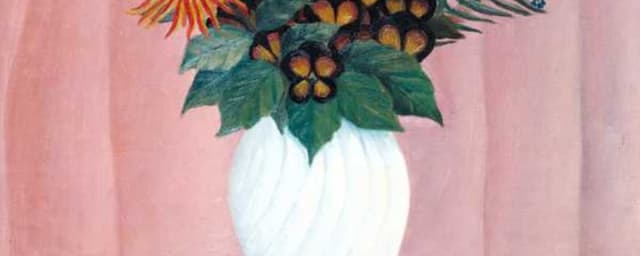
Naïve art
Naive art is the visual language of self-taught makers who create outside the academic tradition, relying on a direct feeling for the world rather than learned rules. Its core is a sincerity of vision in which naivety becomes not a fault but an aesthetic virtue. Formally, such works are marked by flattened space and a deliberate disregard for linear perspective and anatomical proportion. The palette is usually bright, local and decorative, without tonal gradation or academic chiaroscuro modelling. Composition tends toward symmetry, ornament and an even filling of the surface, where every detail is rendered with equal attention. Motifs are drawn from folklore, everyday life, religious subjects, and flora and fauna, often fantastical. The technique may be intentionally simplified, yet it astonishes with confident line and bold colour. In the international context the movement's classic figure is the Frenchman Henri Rousseau (the Douanier), with his fairy-tale jungles. In Ukrainian art the naive impulse reached world stature in the work of Maria Prymachenko, with her fantastical beasts and flowers. The circle of masters also includes the Lemko Nikifor Krynytsky (Epifaniy Drovniak), a singular watercolour chronicler of the provinces. Naive art is closely akin to primitivism and folk painting, yet it preserves an inimitable authorial voice. It influenced the avant-garde, which sought in it a pristine freshness. Today the movement is prized for its authenticity, decorative power and capacity to renew the very idea of artistic truth.
Read more →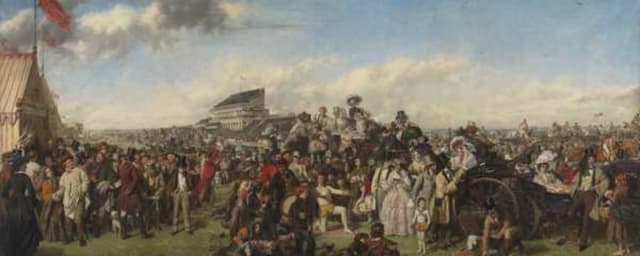
Narrative
Narrative art is art that tells a story, that is, conveys a sequence of events, actions or states unfolding in time. Unlike a purely decorative or non-objective work, a narrative image prompts the viewer to 'read' what is depicted as an episode of a story — with characters, conflict and development. A story can be told within a single picture, seizing the decisive moment, or through a series of images or a sequence of scenes that unfold gradually. Sources of subject matter have traditionally been mythology, religion, history and literature. Narrative is one of the oldest functions of visual art: from the reliefs of ancient civilizations and Trajan's Column to medieval stained glass and frescoes that conveyed biblical stories to an illiterate congregation. In Renaissance and Baroque painting artists reached heights in rendering the dramatic climax of events. A special variety is narrative in series — such as the 'modern moral subjects' of William Hogarth. In the twentieth century the narrative impulse was transformed into the comic, the photo-series, video and performance art. The capacity to tell stories remains a powerful means for art to address memory, history and human experience.
Read more →
Naturalism
Naturalism is a broad nineteenth-century movement aimed at depicting subjects as close as possible to the way the eye perceives them, without idealisation, embellishment or convention. In painting, Naturalism is bound up with the pursuit of objective truthfulness: artists worked out of doors, carefully observed light, atmosphere and the details of nature and everyday life, and often turned to the lives of peasants and workers. Naturalism is closely interwoven with Realism but stresses precisely the fidelity of visual impression and a scientific, observational approach in keeping with the positivist spirit of the age. In French art its forerunners were the Barbizon school and Jules Bastien-Lepage, whose scenes of rural life influenced whole generations of artists in various countries, including Ukraine. Naturalism was also an important concept in literature, where Émile Zola advocated an almost scientific study of society. In the visual arts the naturalist approach prepared the ground for Impressionism with its attention to immediate perception, while remaining an independent and enduring artistic outlook.
Read more →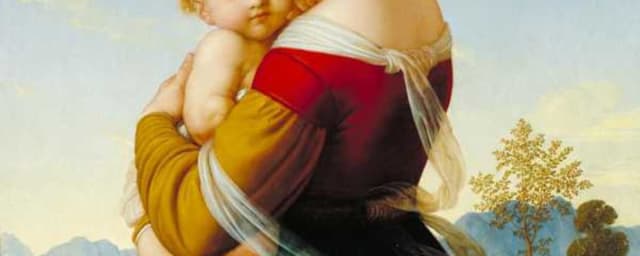
Nazarenes
The Nazarenes were a group of German Romantic painters founded in 1809 whose aim was to revive German painting through a return to the sincerity and spiritual purity of early Renaissance and medieval art. The association arose in Vienna under the name the Brotherhood of Saint Luke (Lukasbund), and soon its members moved to Rome, where they settled in the disused monastery of San Isidoro. The founders of the movement were Friedrich Overbeck and Franz Pforr, later joined by Peter von Cornelius, Wilhelm Schadow, Julius Schnorr von Carolsfeld and others. The nickname Nazarenes was given to them jokingly on account of their pious way of life, their long hair in the manner of images of Christ and their emphatic religiosity. The artists sought to restore moral and spiritual seriousness to art by emulating Raphael, Perugino, Dürer and other masters before the Mannerist age, and they favoured religious and historical subjects, clear line, bright colour and fresco painting. The Nazarenes revived interest in monumental fresco and had a significant influence on nineteenth-century religious art, as well as indirectly on the English Pre-Raphaelites, who shared similar ideals.
Read more →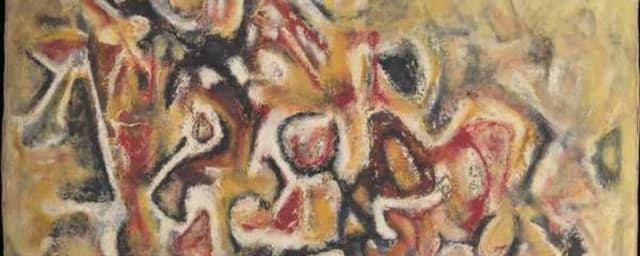
Négritude
Négritude is an anti-colonial cultural and political movement founded by a group of African and Caribbean students in Paris in the 1930s, who sought to affirm the value of black identity and African culture that colonialism had despised. The key figures of the movement were the poet and future president of Senegal Léopold Sédar Senghor, the Martinican poet and politician Aimé Césaire, who actually coined the term, and the French Guianese writer Léon Damas. Négritude rejected the inferiority imposed by the colonisers, asserting pride in a shared African heritage, spirituality and aesthetics. Although the movement began chiefly in literature, it had a profound influence on the visual arts: artists of Africa, the Caribbean and the African diaspora drew on traditional forms, masks, sculpture and ornament to create a modern language of decolonised self-awareness. Négritude echoed the broader currents of Pan-Africanism and contributed to the cultural upsurge of the era of independence struggles among African states in the mid-twentieth century. It remains one of the most important intellectual movements to rethink race, identity and cultural dignity.
Read more →
Neoclassicism
Neoclassicism is an especially pure, austere form of classicism that arose in European art from about 1750 and prevailed into the early nineteenth century. The movement emerged as a reaction against the playful splendour of Rococo and was inspired by the new archaeological discoveries of the ancient cities of Pompeii and Herculaneum, as well as by the ideas of Enlightenment rationalism and the theoretical writings of Johann Joachim Winckelmann, who proclaimed as an ideal the 'noble simplicity and quiet grandeur' of Greek art. Neoclassicism turned to the strict line, clear composition, balance, restrained colour and heroic or moralising subjects drawn from ancient history and mythology. In painting its most eminent exponent was Jacques-Louis David, whose canvases combined classical form with the civic pathos of the French Revolution; he was followed by Jean-Auguste-Dominique Ingres. In sculpture the leading masters were Antonio Canova and Bertel Thorvaldsen. Neoclassicism shaped the appearance of government buildings, museums and monuments across Europe and America, and its influence is felt in Ukrainian art and architecture of the late eighteenth and early nineteenth centuries.
Read more →
Neo-concrete
Neo-concrete art is an offshoot of the Brazilian concrete art movement that arose in the late 1950s in Rio de Janeiro as a call to restore to strictly geometric abstraction more sensuousness, colour, poetry and a human dimension. In 1959 a group of artists issued the 'Neo-Concrete Manifesto', written chiefly by the critic and poet Ferreira Gullar, in which they rejected the mechanistic, rationalist dogmatism of concrete art and stressed the living, bodily perception of the work. The leading figures of the movement were Lygia Clark and Hélio Oiticica. Clark created the 'Bichos' — hinged metal 'creatures' that the viewer could manipulate — while Oiticica developed coloured spatial constructions and later the 'Parangolés', cape-like garments to be worn and danced in. Neo-concrete art broke down the boundary between work and viewer, turning art into an interactive, sensory and even performative experience. The movement was short-lived, lasting into the early 1960s, but it exerted an enormous influence on later Latin American and world art, anticipating the participatory and corporeal practices of subsequent Conceptualism.
Read more →
Neo-dada
Neo-Dada is a term applied to the work of artists active in the United States in the 1950s and early 1960s whose art recalled the Dada movement of the early twentieth century in its irony, its use of everyday objects and its unsettling of the boundaries between art and life. Neo-Dada arose as a reaction against the then-dominant Abstract Expressionism with its pathos of inner experience; instead, younger artists turned to found objects, collage, readymades, popular-culture imagery and a detached, sometimes cool presentation. The most distinctive figures of the movement were Robert Rauschenberg, with his 'Combines' — hybrids of painting and assemblage incorporating real objects — and Jasper Johns, with his series of flags, targets and numbers that questioned the nature of image and sign. The composer John Cage played a significant role, his ideas of chance and everyday sound nourishing this circle. Neo-Dada became a direct bridge to Pop art, Fluxus and Conceptual art, reintroducing the Dada spirit of play, provocation and critique of artistic convention into postwar culture.
Read more →
Neo-expressionism
Neo-Expressionism is an international phenomenon of a powerful revival of painting in an expressionist spirit in the 1980s, which arose as a reaction against the dominance of Minimalism and Conceptual art in the preceding decade. Neo-Expressionists returned to the large-format, emotionally charged, figurative canvas with dense texture, energetic and sometimes deliberately crude brushwork, saturated colour and tense, dramatic imagery drawn from history, myth, national trauma and personal experience. The movement unfolded in parallel in several countries. In Germany it was embodied by the so-called 'Neue Wilden', including Georg Baselitz, Anselm Kiefer, who reflected on the burden of national history, and Jörg Immendorff. In Italy the parallel tendency of the Transavanguardia developed with Francesco Clemente and Enzo Cucchi. In the United States Neo-Expressionism includes Jean-Michel Basquiat and Julian Schnabel. The movement restored painting to a central place on the art scene and market, though critics charged it with excessive theatricality and commercialisation. Neo-Expressionism remains an emblematic example of the cyclical return to painting and expressive figuration in the age of late Modernism and early Postmodernism.
Read more →
Neo-geo
Neo-Geo (short for 'Neo-Geometric Conceptualism') is a term that came into use in the early and mid-1980s in the United States, above all in New York, to describe the work of a group of artists whose art critically reflected on the mechanisation, consumerism and total commercialisation of the modern world. Neo-Geo combined a cold, impersonal geometric abstraction with a conceptual and theoretical stance, drawing on postmodern ideas of simulation and the critique of the sign. The artists deliberately borrowed the formal language of early abstract art and Minimalism but stripped it of spiritual or utopian pretensions, turning it into an empty, ironically quoted sign. The leading figures of the movement are considered to be Peter Halley, who painted bright canvases with 'cells' and 'conduits' as metaphors for alienated urban space, as well as Jeff Koons with his glossy objects of mass culture, Haim Steinbach and Ashley Bickerton. Neo-Geo reflected the mood of critical Postmodernism, in which art analyses its own commodity nature and place within the sign systems of late capitalism, and it became a notable phenomenon of the late twentieth-century art market.
Read more →
Neo-impressionism
Neo-Impressionism is the name given to the Post-Impressionist work of Georges Seurat, Paul Signac and their followers, who painted by applying small adjacent touches or dots of pure colour so that, seen from a distance, these hues would mix optically in the viewer's eye, reproducing the vibration of light. This technique is known as Pointillism or Divisionism. The movement arose in the mid-1880s in France and drew on contemporary scientific theories of colour and visual perception, notably the writings of Michel Eugène Chevreul and Ogden Rood. Unlike spontaneous Impressionism, Neo-Impressionism sought a systematic, almost methodical approach, and its compositions are marked by a balanced, harmonious structure and a sense of frozen monumentality. The programmatic work is considered to be Seurat's large canvas 'A Sunday on La Grande Jatte' (1884–1886). Signac became the chief theorist and populariser of the method, setting out its principles in his book 'From Eugène Delacroix to Neo-Impressionism'. The movement influenced Fauvism and the further development of abstract colour, and its ideas spread through many European schools.
Read more →
Neo-plasticism
Neo-Plasticism is the term adopted by the Dutch pioneer of abstract art Piet Mondrian to designate his own type of abstract painting, which reduced the image to the simplest elements: only horizontal and vertical black lines forming a grid, and fields filled with the three primary colours — red, blue and yellow — in combination with white, black and grey. Mondrian developed this language around 1917 to 1920 within the De Stijl movement, founded together with Theo van Doesburg. The name derives from the Dutch 'Nieuwe Beelding', 'new formation'. Mondrian sought to express a universal, timeless harmony and spiritual equilibrium, purging art of all figuration, individual feeling and chance. He believed that the strict balance of opposites — vertical and horizontal, colour and colourlessness — reflected the fundamental order of being. Neo-Plasticism exerted a profound influence on the architecture, design, typography and applied arts of the twentieth century, becoming one of the defining languages of geometric abstraction and a foundation of later modernist design.
Read more →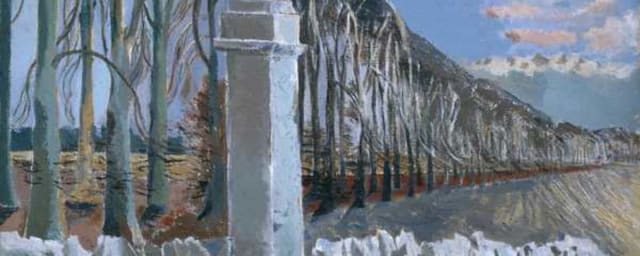
Neo-romanticism
Neo-Romanticism is a term applied to the imaginary and often quite abstract landscape paintings of the British artists Paul Nash, Graham Sutherland and others in the late 1930s and the 1940s. The movement arose as a kind of revival of the spirit of nineteenth-century English Romanticism — of William Blake, Samuel Palmer and John Martin — in response to the anxieties of the pre-war and wartime years. The Neo-Romantics turned to the native landscape as a source of mystical, poetic and sometimes eerie experience, endowing hills, trees, ruins and ancient stones with a sense of spiritual presence and historical depth. Their landscapes are full of melancholy, solitude and charged atmosphere, and their forms often approach surrealist deformation and symbolic generalisation. The circle of Neo-Romantics also included John Piper, John Minton and the young Lucian Freud in his early phase. The movement played an important role in British wartime and postwar art, notably in the work of the official war artists, and expressed a yearning to seek spiritual roots and national identity in the landscape of the homeland.
Read more →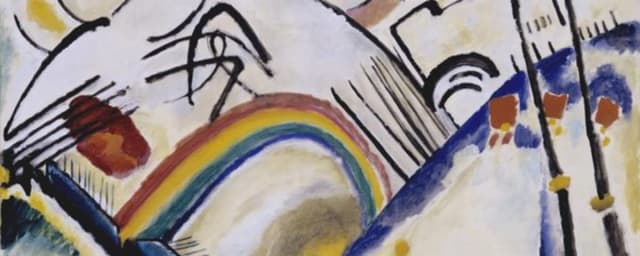
Neue Künstlervereinigung München (NKV)
The New Artists' Association of Munich (German Neue Künstlervereinigung München, abbreviated NKV) is an avant-garde exhibiting society founded in Munich in 1909 by a group of artists dissatisfied with the conservatism of the official art associations. The association sought to establish a new art free of academicism, oriented toward spiritual content, symbolism and an increasingly bold treatment of colour and form at the threshold of abstraction. Wassily Kandinsky became chairman of the society, and among its leading members were Alexej von Jawlensky, Marianne von Werefkin, Gabriele Münter and Adolf Erbslöh. The NKV mounted several exhibitions that introduced the Munich public to the newest European tendencies, including Fauvism and Cubism. However, tension grew within the group between the moderate members and the more radical wing led by Kandinsky, who was moving ever more decisively toward non-objective art. In 1911, following a sharp split, Kandinsky, Franz Marc and Münter left the association and founded the famous Blue Rider (Der Blaue Reiter). The NKV thus served as an important intermediate stage from which one of the most influential movements of German Expressionism grew.
Read more →
Neue Sachlichkeit
New Objectivity (German: Neue Sachlichkeit) was a German art movement of the 1920s that emerged as a reaction against the emotionalism of Expressionism and the idealism of the pre-war avant-garde. The name was coined in 1925 by curator Gustav Hartlaub for an exhibition in Mannheim that gathered a generation of artists who had turned toward a sober, critical, almost clinical realism. Practitioners of New Objectivity depicted the post-war reality of the Weimar Republic without embellishment: maimed veterans, prostitutes, profiteers, social inequality, and the moral decay of the big cities. Leading figures included Otto Dix, George Grosz, and Max Beckmann, whose sharply satirical canvases exposed the cynicism and brutality of the era. The style combined cold precision of detail with biting social commentary. The Nazi rise to power in 1933 ended the movement: many works were branded as degenerate art, confiscated, or destroyed. New Objectivity remains one of the most penetrating testimonies to the interwar crisis in European culture.
Read more →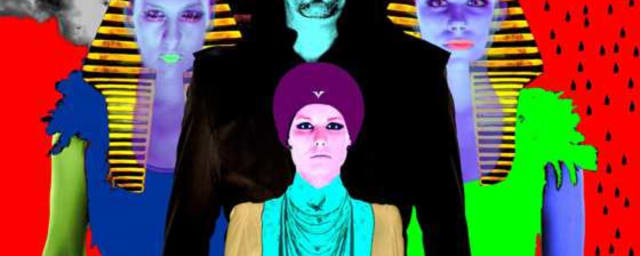
Neue Slowenische Kunst (NSK)
Neue Slowenische Kunst (NSK, "New Slovenian Art") was a pioneering artistic collective founded in 1984 in Slovenia, then part of socialist Yugoslavia. The organization arose at the intersection of several groups: the music band Laibach, the painting collective Irwin, and the Scipion Nasice Sisters Theatre department, later joined by design and philosophy divisions. NSK worked with a provocative "retro-avant-garde" aesthetic, appropriating and reworking totalitarian iconography — the symbolism of the avant-garde, Socialist Realism, and fascism — in order to expose the mechanisms of ideological manipulation. This strategy of "over-identification" triggered sharp public debate. In 1992, following the breakup of Yugoslavia, the collective proclaimed itself a "state in time" — the NSK State, a virtual country without territory that issues its own passports and operates as a conceptual citizenship project. NSK's activity became one of the most influential forms of postmodern political art in Central and Eastern Europe at the end of the twentieth century.
Read more →
Neue Wilde
Neue Wilde ("New Wild Ones") is a term used in Germany for Neo-Expressionism, the turbulent revival of expressive painting in the late 1970s and 1980s. The name alludes to the "wild ones" — the Fauves of the early century — and emphasizes the spontaneity, energy, and emotional immediacy of a new generation of artists. After decades dominated by Conceptualism, Minimalism, and abstraction, young painters returned to figuration, vivid color, broad impasto brushwork, and large formats. In Germany the movement had two centers: the Berlin circle with figures such as Rainer Fetting and Helmut Middendorf, and the Cologne scene around Walter Dahn and Hans Peter Adamski. Neue Wilde painting was often autobiographical, urban, nocturnal, and saturated with motifs of subculture and music. The movement paralleled the Italian Transavantgarde and American Neo-Expressionism, becoming part of a wider international return to painting in the 1980s.
Read more →
New British sculpture
New British Sculpture is a term applied to the work of young British sculptors of the 1980s who, reacting against the austerity of Minimalism and the intellectual asceticism of Conceptual art, chose a freer, more playful and imagistic approach to materials, techniques, and subjects. Instead of industrial impersonality, they turned to found objects, domestic junk, cheap industrial materials, and bright color, transforming everyday things into poetic or ironic objects. Leading figures of the movement include Tony Cragg, Richard Deacon, Bill Woodrow, Anish Kapoor, and Edward Allington. Their works often balanced between abstraction and the suggestion of recognizable forms, raising questions of consumerism, urban life, and humanity's relationship with the material world. Many of these artists gained international recognition through exhibitions at the Lisson Gallery in London. New British Sculpture restored tactility, wit, and metaphor to the language of three-dimensional art and significantly influenced the subsequent generation of British artists.
Read more →
New English Art Club
The New English Art Club was an exhibiting society of artists founded in London in 1886 by painters influenced by French Impressionism whose work was rejected by the conservative Royal Academy. The club arose as an alternative to the academic system and sought to provide an independent platform for a younger generation of painters, many of whom had trained in Paris and adopted the plein-air methods and bright palette of the French masters. Among its founders and early members were John Singer Sargent, Philip Wilson Steer, George Clausen, Stanhope Forbes and, later, Walter Sickert, who played a leading role in the society's affairs. In the late 1880s Sickert and Steer formed an 'impressionist nucleus' within the club, staging their own exhibition, London Impressionists, in 1889. The New English Art Club became an important centre of progressive British art at the turn of the century and helped to disseminate Impressionist and realist tendencies in Britain. The society continues to exist today, preserving the tradition of figurative painting from life.
Read more →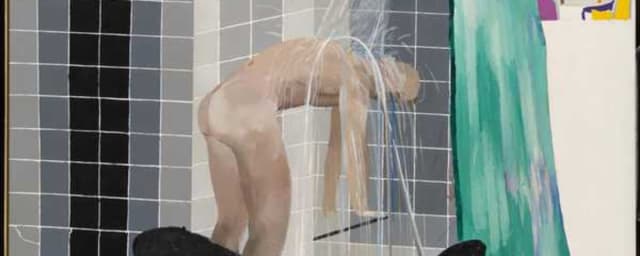
New figuration
New Figuration is a general term for the revival of figurative art in Europe and America in the 1960s, following a period dominated by Abstract Expressionism and geometric abstraction. Artists of this tendency reintroduced the human figure and the recognizable object world into the language of modern painting — not as a mere continuation of tradition, but in a new, often sharp, critical, and expressive key. New Figuration absorbed the lessons of abstraction — free brushwork, distortion, color expression — and combined them with social, psychological, and political content. In France and Spain the tendency took the form of Nouvelle Figuration and "narrative figuration" with artists such as Erró and Jacques Monory; in Britain it is associated with Francis Bacon and Lucian Freud. The movement paralleled the emergence of Pop art but retained greater drama and existential tension. New Figuration became an important link in the reassessment of the role of the human image in the art of the second half of the twentieth century.
Read more →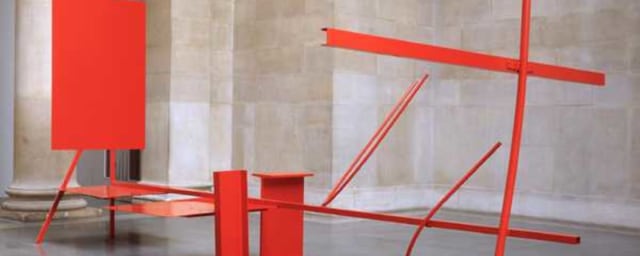
New generation sculpture
New Generation Sculpture is the name given to the work of a group of young British sculptors active in the 1960s who experimented with new materials, forms, and bright color. The term derives from the "New Generation" exhibition series held at London's Whitechapel Gallery, notably the influential 1965 show that presented a generation of Anthony Caro's students at St Martin's School of Art. These sculptors abandoned traditional materials such as bronze and stone in favor of industrial steel, fiberglass, and painted metal. Their works were abstract, colorful, and often placed directly on the floor without a pedestal, changing the viewer's relationship with the object. Key figures include Phillip King, William Tucker, Tim Scott, and David Annesley. Vivid color played an independent role, bringing sculpture closer to the experience of painting. New Generation Sculpture became the British counterpart to international tendencies toward lightness, color, and abstraction in the three-dimensional art of the 1960s.
Read more →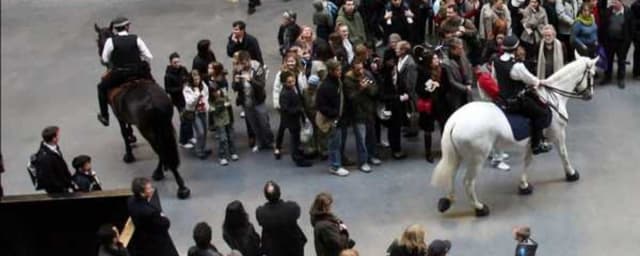
New genre public art
New Genre Public Art is a form of public art that is often activist in character and created outside museum and institutional structures with the aim of directly engaging a particular community in co-creation and dialogue. The term was introduced by American artist Suzanne Lacy in the late 1980s and early 1990s, generalizing practices in which content, rather than form, defines the work. Unlike traditional monuments or plaza sculptures, New Genre Public Art focuses on social issues — gender inequality, racism, poverty, ecology, and the rights of marginalized groups. The artist acts more as an organizer of a process than as the author of a finished object, and the community itself becomes a co-author. Projects may last months or years and take the form of performances, meetings, actions, and educational initiatives. This tendency is closely linked to participatory and socially engaged art and expanded the understanding of where and for whom art exists in public space.
Read more →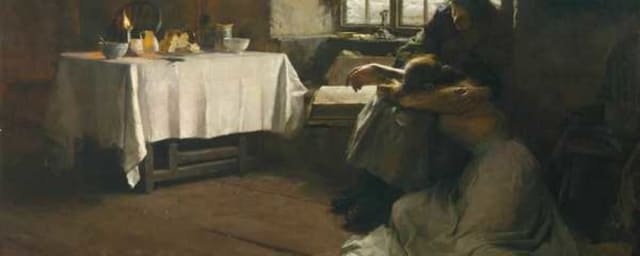
Newlyn school
The Newlyn School was a group of artists who settled in the fishing village of Newlyn and neighbouring towns of Cornwall in the late nineteenth century and whose art is marked by the influence of plein-air painting and realism. The artists were drawn to Newlyn by the soft coastal light, the inexpensive living, the picturesque scenery of the shore and the opportunity to work in the open air, depicting the everyday life of the fishing community. The leading figure of the school was Stanhope Forbes, sometimes called its father; the circle also included Walter Langley, Frank Bramley, Elizabeth Forbes and others. The artists followed the method of the French painter Jules Bastien-Lepage, working out of doors and paying particular attention to the truthful rendering of natural light and atmosphere. Their paintings depicted scenes of the labour and daily life of fishermen, dramatic episodes of maritime life such as the waiting for boats or a leave-taking, and often carried a distinct social and emotional charge. In 1895 an art gallery opened in Newlyn, attesting to the importance of the colony. The Newlyn School became one of the best-known British art colonies and made a notable contribution to the development of realist plein-air painting in Britain.
Read more →
New media
New media is a term used to describe complex new technologies that became available to artists from about the late 1980s and that enable the digital production and distribution of art. It includes computer graphics, digital video and sound, interactive installations, virtual and augmented reality, robotic systems, and networked and software art. Their common feature is the use of computing technology not merely as a tool but as the very environment and material of the work, often interactive, time-based and reproducible without loss of quality. New media grew out of the traditions of video art, kinetic and Conceptual art, and with the spread of personal computers and the Internet it became an independent field of contemporary practice. Artists explore questions of code, algorithms, artificial intelligence, surveillance, identity and human-machine interaction. Leading institutions and festivals, such as Ars Electronica in Linz, have institutionalised the field. In Ukraine new-media art develops actively at media festivals and in digital projects, combining technological experiment with social and cultural statement.
Read more →
New sculpture
New Sculpture is a term denoting a tendency in British sculpture of the second half of the nineteenth century, roughly from the 1880s to the early 1900s. It emerged as a reaction against the frozen neoclassicism and static quality of earlier Victorian sculpture. New Sculpture artists sought greater naturalism, psychological expressiveness, poetry, and symbolic content, drawing at the same time on the influence of the French school and the Italian Renaissance. They paid particular attention to surface, movement, detail, and subtle modeling, often combining different materials — bronze, ivory, colored enamels, and precious stones. Leading figures of the tendency include Frederic Leighton, author of the landmark "An Athlete Wrestling with a Python," Alfred Gilbert, Hamo Thornycroft, and Alfred Drury. New Sculpture also promoted the development of the decorative statuette and closely echoed the Arts and Crafts movement and Art Nouveau. It substantially renewed British sculpture and prepared the ground for the modernist sculpture of the twentieth century.
Read more →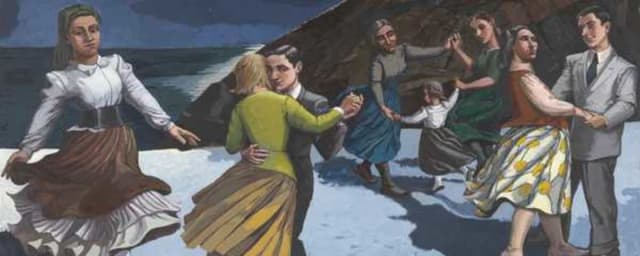
New spirit painting
New Spirit Painting is a term associated with the revival of expressionist, figurative painting around the turn of the 1970s and 1980s. The name derives from the influential exhibition "A New Spirit in Painting," held in 1981 at the Royal Academy of Arts in London under the curatorship of Christos Joachimides, Nicholas Serota, and Norman Rosenthal. This show proclaimed the return of painting as a leading art form after a decade dominated by Conceptual, Minimalist, and performance art that had questioned the very relevance of painting. The exhibition combined established masters — Picasso, Matisse, Bacon — with a younger generation of expressive artists, including Georg Baselitz, Anselm Kiefer, Julian Schnabel, and Francesco Clemente. New Spirit Painting affirmed emotionality, subjectivity, large scale, saturated color, and a return to historical, mythological, and personal subjects. The exhibition became one of the manifestos of international Neo-Expressionism and testified to the restored status of traditional painting in the art of the 1980s.
Read more →
New topographics
New Topographics is a term introduced by the curator William Jenkins in 1975 to describe a group of American photographers whose predominantly black-and-white prints of the urban and suburban landscape shared a similar, deliberately banal aesthetic. The name comes from the exhibition New Topographics: Photographs of a Man-Altered Landscape, held that year in Rochester. Its circle of authors included Robert Adams, Lewis Baltz, Bernd and Hilla Becher, Stephen Shore and others. These photographers abandoned the romantic, sublime depiction of pristine nature in favour of a restrained, almost neutral documentation of human-altered spaces, parking lots, warehouses, tract housing, industrial zones and suburbs. Their cool, dispassionate gaze raised questions about the impact of industrialisation, consumption and development on the environment. New Topographics decisively influenced the later development of landscape and conceptual photography, inspiring a generation of authors worldwide, including those who explore the post-industrial and transformed landscapes that are also relevant to Ukraine.
Read more →
New Wave / Transavant-garde
The New Wave (the Ukrainian Transavant-garde) was an explosion of young nonconformist art in Ukraine of roughly 1987 to 1999, coinciding with the era of Perestroika, the collapse of the USSR and the achievement of independence. The term "Transavant-garde" derives from the concept of the Italian critic Achille Bonito Oliva, who used it to name a return to grand, emotional, figurative painting after Conceptualism; on Ukrainian soil it acquired its own rebellious ring. The key idea of the era was a radical liberation from ideological and aesthetic prohibitions, an ironic reworking of the Soviet and classical heritage, corporeality, myth-making and a monumental, often expressive large-format painting. The hearth of the movement was the Kyiv squat on Paris Commune Street, where young artists lived and worked. Its signature figures were Arsen Savadov and Heorhiy Senchenko, whose canvas "The Sorrow of Cleopatra" (1987) became the manifesto of a generation, together with Oleg Golosiy, Oleksandr Hnylytsky, Vasyl Tsagolov, Dmytro Kavsan and Yuriy Solomko. Their art fused pathos with play, post-totalitarian freedom with postmodern quotation, restoring scale and sensuality to painting. In the late 1980s the first independent centres also emerged in Kyiv, such as the Soviart gallery (1987), which brought the nonconformists before the public. By the end of the 1990s the turbulent neo-expression of the New Wave was gradually supplanted by conceptual, photographic and video practices, which prepared the language of mature contemporary art. The New Wave brought Ukrainian art out of the underground into the public and international arena, forming the first generation of free artists of an independent state. This turbulent, brief era closed the Soviet age and directly prepared the institutional coming-of-age of contemporary Ukrainian art in the decades that followed.
Read more →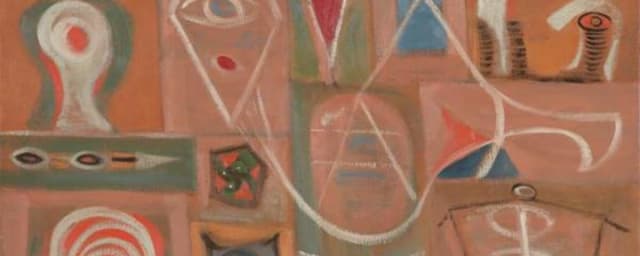
New York school
The New York School was a radical art scene that emerged in New York after the Second World War and, for the first time, made that city rather than Paris the principal centre of avant-garde art in the Western world. The term primarily encompasses the Abstract Expressionist artists who worked in the 1940s and 1950s, notably Jackson Pollock, Willem de Kooning, Mark Rothko, Barnett Newman, Clyfford Still, Franz Kline, Robert Motherwell and Arshile Gorky. Despite significant differences of individual manner, from the energetic action painting of dripped and splashed paint to contemplative fields of pure colour, these artists were united by a striving for large scale, non-representation, spontaneity and the expression of deep emotional and existential states. The movement's formation was influenced by European Surrealism, whose representatives emigrated to the United States during the war, and by ideas of automatism and psychoanalysis. The notion of the New York School is sometimes extended to an associated circle of poets, musicians and dancers. This scene, supported by the influential critics Clement Greenberg and Harold Rosenberg, exerted a decisive influence on all the subsequent development of twentieth-century art.
Read more →Nude
A genre of the visual arts whose subject is the unclothed human body; Ukrainian art history also uses the synonym akt.
Read more →



