




Art terms on "K"
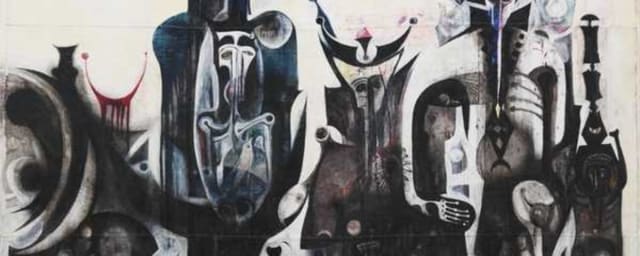
Khartoum School
The Khartoum School was a modernist art movement that emerged in Sudan around 1960 and sought to develop a new visual vocabulary to express the unique identity of the newly independent nation after the country gained independence in 1956. The movement centred on the College of Fine and Applied Art in Khartoum, and its leading figures were the artists Ibrahim el-Salahi, Ahmed Shibrain and Kamala Ibrahim Ishag. The artists of the school aimed to combine the influences of Western modernism with local sources: Arabic calligraphy, Islamic ornament, African motifs and the traditions of Sudanese material culture. Central to their aesthetic was the notion of hurufiyya, the creative use of Arabic letters and calligraphic signs as plastic, almost abstract compositional elements. In this way the artists sought to reflect the dual, African and Arab-Islamic, heritage of Sudanese culture and to establish a distinctive postcolonial art. Ibrahim el-Salahi later achieved international recognition as one of the foremost masters of African modernism. The Khartoum School occupies an important place in the history of modern African and Arab art.
Read more →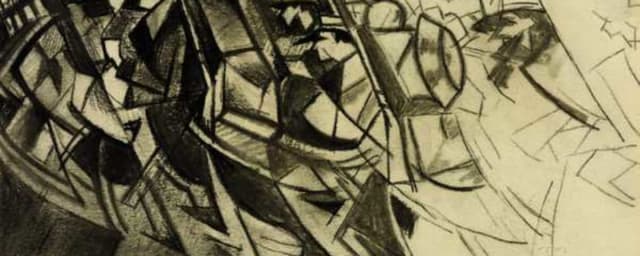
Kinaesthetic art
Kinaesthetic art is a tendency that explores the body in motion and the bodily sensation of movement as its central subject and means of expression. Unlike kinetic art, in which the objects themselves move, kinaesthetic art focuses on proprioception — the internal sense of the position and displacement of one's own body, on muscular effort, balance and gesture. The term was first associated with Futurism and later became bound up with performance, dance, the happening and practices that emerged in the second half of the twentieth century, when artists began to treat the movement of viewer or performer as an autonomous material. The kinaesthetic approach intersects with developments in experimental dance, notably postmodern choreography, and with installations that prompt the visitor to move, lean or balance in order to perceive the work. Here emphasis shifts from purely visual contemplation to a bodily, somatic experience of space. Kinaesthetic art widens the definition of an artistic medium by placing the living, moving, sentient human body at its centre.
Read more →
Kinetic art
Kinetic art is a movement in which motion is the defining means of artistic effect: works either genuinely move — by means of motors, air currents, magnets or manual intervention — or create the illusion of movement through optical effects. The origins of the tendency reach back to the Constructivist experiments of Naum Gabo and Antoine Pevsner and to Marcel Duchamp's 'Bicycle Wheel' (1913). Kinetic art flourished in the 1950s and 1960s, building on the mobile, which Alexander Calder had been making since around 1930 — a suspended moving sculpture so finely balanced that the slightest breath of air sets it in motion. Other key figures include Jean Tinguely, with his self-destroying machines, Jesús Rafael Soto and Julio Le Parc. Kineticism is closely interwoven with Op art, in which movement is simulated by static geometric patterns. The art of movement reflected a fascination with technology, energy and time as an artistic dimension, dissolving the traditional idea of sculpture as a motionless, eternal object and drawing the viewer into a dynamic, changing spectacle.
Read more →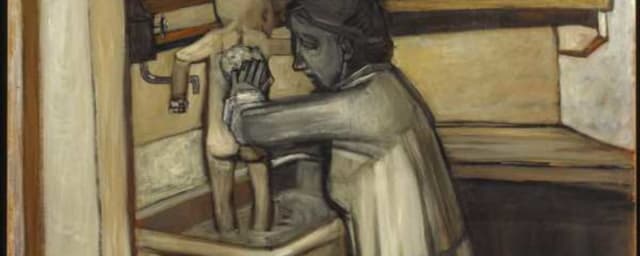
Kitchen Sink painters
The Kitchen Sink painters were a group of British artists working in the 1950s who depicted ordinary people in scenes of everyday, often drab and unappealing life. The term was first used by the critic David Sylvester as the title of an article in the December 1954 issue of Encounter, alluding to John Bratby's paintings of kitchen sinks, and ironically points to the artists' desire to show the most mundane and down-to-earth aspects of working-class domestic life: cluttered kitchens, cramped flats, dirty dishes and objects of daily use. The group included John Bratby, Jack Smith, Edward Middleditch and Derrick Greaves, whom the critic David Sylvester brought together under this label in the mid-1950s. Their style was marked by thick, vigorous brushwork, a muted palette and a pronounced social orientation. The movement was part of a broader tendency in British culture of the postwar decade, the so-called social realism and the literature of the Angry Young Men, which addressed themes of class, everyday life and social inequality. The work of the Kitchen Sink painters was set against both abstraction and salon aestheticism and represented British art at the Venice Biennale of 1956. Later some members, notably Bratby, moved away from this manner.
Read more →
Kitsch
Kitsch is an artistic category and aesthetic denoting mass-produced, replicated goods aimed at an undemanding taste, easy emotional sentiment and instant effect in place of depth or innovation. The term took hold in the late nineteenth and early twentieth centuries alongside the growth of the entertainment and consumer industries. The kitsch aesthetic rests on excessive sentimentality, sweetness, ostentatious luxury and the imitation of "high" art in a cheap, simplified form. Its formal marks are garish, saccharine colours, a surfeit of ornament and gilding, formulaic touching subjects (weeping children, kittens, romantic sunsets), exaggerated showiness and the mechanical copying of acknowledged masterpieces. Modernist theorists, notably Clement Greenberg in his programmatic essay "Avant-Garde and Kitsch" (1939), opposed kitsch to genuine art as its surrogate and a symptom of mass culture. In the second half of the twentieth century, however, attitudes grew more complex: Pop Art and later postmodernism began deliberately to play with kitsch, to quote it ironically and to aestheticize "bad taste." Jeff Koons transformed kitsch souvenirs and toys into monumental objects, Pierre et Gilles created a glossy camp imagery, and the notion of "camp" legitimized a love of deliberate excess. Thus kitsch turned from a term of abuse into a fully-fledged instrument of artistic strategy. Today it remains an important field for reflection on the mechanisms of taste, the mass production of images and the boundary between irony and sincerity in consumer culture.
Read more →Kosiv craft centre
The body of folk and professional crafts centred on the town of Kosiv and nearby villages of Hutsulshchyna, above all Kosiv painted ceramics and hand weaving (lizhnyk blankets and carpets). These are two distinct traditions that share one centre and one training school.
Read more →Krolevets weaving
The tradition of hand pattern weaving (perebir technique) of the town of Krolevets in Sumy Oblast, best known for the red-and-white Krolevets rushnyk.
Read more →
Kyivan Rus
Kyivan Rus (882–1240) was the first great East Slavic state, centred on Kyiv, which united lands from the Baltic to the Black Sea and laid the foundations of the Ukrainian cultural tradition. Its pivotal event was the Christianisation of Rus under Prince Volodymyr the Great in 988, which drew the state into the orbit of Byzantine civilisation. With Christianity came monumental stone architecture, icon painting, mosaic, fresco and book culture. The summit of the age is the Cathedral of St Sophia in Kyiv, raised under Yaroslav the Wise: its interior is adorned with gold-ground mosaics — among them the majestic "Orans" of the central apse — and extensive fresco cycles, including secular scenes of the princely court. Alongside it rose the Church of the Tithes, the Kyiv-Pechersk Lavra — cradle of Rus monasticism and chronicle-writing — and the Saviour Cathedral in Chernihiv. At St Sophia, Rus chronicle-writing was born, crowned by the "Tale of Bygone Years" of the monk Nestor. The art of Rus fused the Byzantine canon with a local sensibility: elongated proportions, the spiritual concentration of faces, and richness of ornament in cloisonné enamels, book miniatures and jewellery (the Kyivan kolty, diadems and neck-rings). The political fragmentation of the twelfth century did not halt artistic flowering in the appanage principalities. The Mongol invasion and the fall of Kyiv in 1240 severed the era, yet its spiritual and artistic legacy remained the cornerstone of Ukrainian self-awareness.
Read more →



