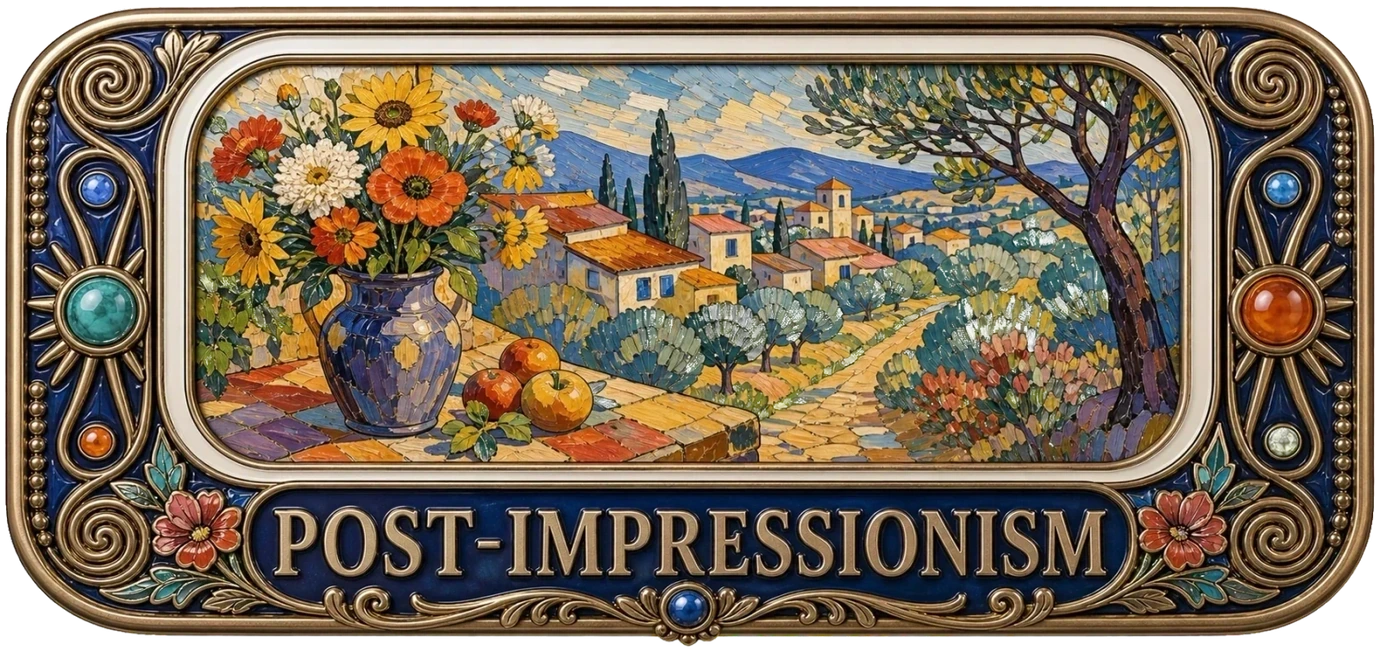
Post-Impressionism is a collective name for the artistic searches that grew out of Impressionism but overcame its fixation on the fleeting impression in favour of enduring form, structure and personal meaning. The movement's shared idea was to return to painting the constructive strength, symbolic depth and emotional tension lost in the pursuit of transient light. Formally, its masters retained the pure, saturated colour of the Impressionists, yet subordinated it to conception rather than to the eye. Paul Cézanne sought in nature a geometric foundation — the cylinder, the sphere, the cone — and built space through the juxtaposition of colour planes, becoming a bridge to Cubism. Georges Seurat devised Pointillism, breaking colour into tiny dots of pure pigment that blend only in the viewer's eye. Vincent van Gogh turned the brushstroke into a vessel of feeling: his swirling, impasto lines pulse with an inner fire. Paul Gauguin turned to Synthetism and symbol, working with large decorative fields of saturated colour and primitive forms. Post-Impressionist composition is deliberate, often flat and decorative, with an emphasised contour. Technically, its artists experimented with texture, the rhythm of the brushstroke and the expression of line. The movement developed in France in the 1880s–1900s and became the foundation of all modern twentieth-century art, feeding Fauvism, Expressionism and Cubism. Today Post-Impressionism is valued for uniting chromatic freedom with intellectual and spiritual depth.













 Chronology & Eras