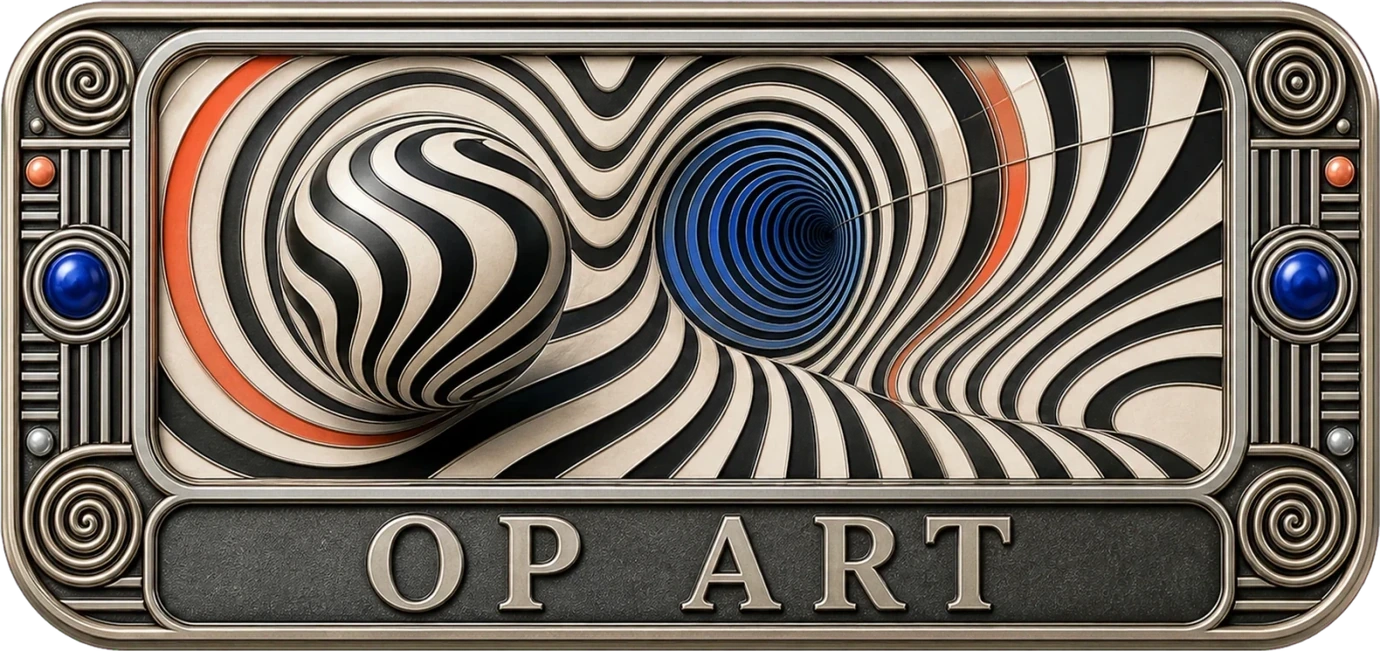
Op art (optical art) is an abstract visual language that investigates the mechanisms of visual perception and provokes illusions of movement on a static surface. Its central idea is to make the eye "see" what is physically absent: vibration, flicker, pulsation and the deformation of space. Formally, op art employs strict geometry — grids, concentric circles, waves, chequerboard and moiré structures. The palette may be starkly black-and-white, where the play is built on the edges of forms, or intensely spectral, where the illusion arises from the interaction of complementary colours. Composition is exactingly calibrated, almost mathematical, stripped of personal brushwork and emotional expression. The technique favours an impeccably smooth, impersonal surface that heightens the optical effect. Such works activate the physiology of sight: after prolonged looking, afterimages and a sensation of swaying appear. The movement took shape in the 1960s, and its manifesto was the exhibition "The Responsive Eye" in New York in 1965. Its leading masters are the Hungarian-French artist Victor Vasarely, called the father of op art, and the Briton Bridget Riley, with her hypnotic black-and-white waves. Op art is related to kinetic art and constructivism, with roots reaching back to the ideas of the Bauhaus. It quickly penetrated design, fashion and advertising. Today the movement is valued for its intellectual rigour, precision and capacity to turn the viewer into a participant in an optical experiment.













 Chronology & Eras