




Socialist realism
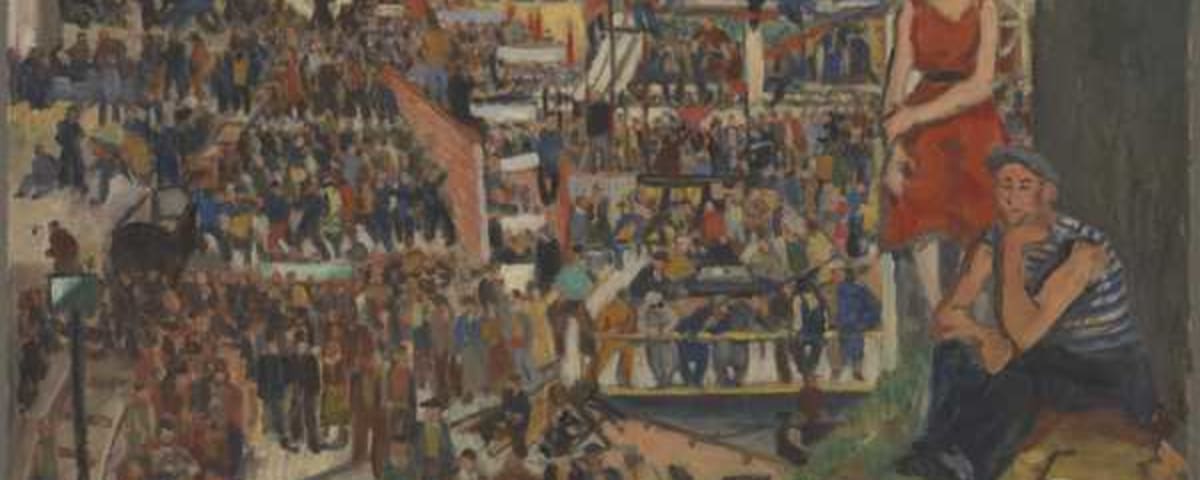
Socialist Realism was the official, ideologically imposed method of Soviet art, dominant from 1932 until the late 1980s. Its foundations were formulated after the Party decree of 1932 on the restructuring of literary and artistic organisations and were consolidated at the Writers' Congress of 1934; its ideologist was Andrei Zhdanov, and the slogan "engineers of human souls" defined the artist's role as that of a propagandist. Its key idea was the depiction of reality "in its revolutionary development" — that is, not as it is but as the Party saw it: heroicised labour, the happy collective farm, the leader, industry, optimism. Formally, Socialist Realism leaned on the academic realism of the nineteenth century, on clear narrative and legibility for the masses, categorically rejecting any formalism or avant-garde. In practice this meant strict censorship, canonical subjects and the cult of the leader. Ukrainian artists of varying stature worked within the era: Tetyana Yablonska in her early period created the famous canvas "Bread" (1949), a model of the style, though she later evolved toward a more individual manner; Serhiy Hryhoriev, Mykola Hlushchenko and Mykhailo Derehus left a substantial legacy. The canon rested on the principles of party spirit, ideological commitment and "popular character," and the artists' unions strictly policed adherence to the method. In the 1960s a more restrained "severe style" matured within its bounds, preparing the ground for a gradual departure from dogma. Socialist Realism was not a style in the natural sense but a system of control that suppressed the avant-garde and Boychukism and for decades defined the limits of the permissible. Its monopoly began to crumble with the Thaw and the Sixties movement, and finally collapsed at the end of the Soviet era, yielding to the underground and to new artistic freedoms.




